
Search is no longer a single destination. Your customers are asking ChatGPT for product recommendations, using Perplexity to research purchases, and relying on Google’s AI Overviews for instant answers. This shift changes what “ranking” means—and what you need to do to be visible.
Traditional SEO focused on earning a position on a results page. AI search optimization focuses on earning a citation inside a generated answer. These are related but not identical challenges. A page that ranks #1 on Google may never be mentioned by ChatGPT if it lacks the structural signals AI models look for when extracting and synthesizing information.
The good news: the fundamentals of SEO haven’t disappeared. They’ve evolved. This guide walks you through exactly how to optimize for the new generation of AI-powered search engines—without abandoning the strategies that still work for traditional search.
What Is AI Search Optimization?
AI search optimization (sometimes called Generative Engine Optimization or GEO) is the practice of structuring your content, technical setup, and off-site presence so that AI-powered search tools—ChatGPT, Perplexity, Google AI Overviews, Bing Copilot—can find, interpret, and cite your content when answering user questions.
Unlike traditional SEO, which optimizes for a ranked list of links, AI search optimization optimizes for extraction. The model reads across multiple sources, identifies relevant passages, and synthesizes an answer. Your goal is to be one of the sources it selects and references.
Why AI Search Optimization Matters in 2026
AI search engines cite a brand’s own domain in only about 16% of responses on average. The majority of citations come from third-party sources—comparison articles, forums, review sites, and industry roundups.
This means a strategy focused solely on owned content will miss most citation opportunities. You need to think beyond your website.
At the same time, when ChatGPT recommends a brand, those recommendations carry significant weight. Research indicates that phone calls referred by ChatGPT qualify as leads more often than calls from any other channel—roughly 10 points above average—because users have already done their research before reaching out.
Being visible in AI answers isn’t a vanity metric. It influences buyers at the moment they’re forming a shortlist.
How AI Search Engines Choose Sources
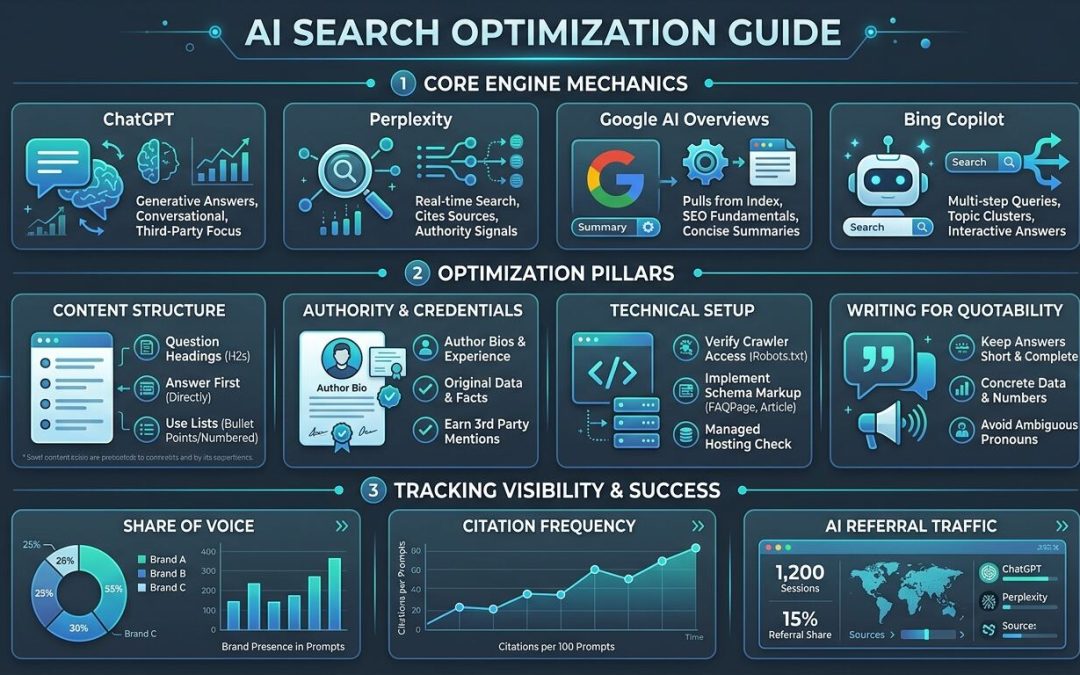
Different AI platforms use different models and retrieval processes. Understanding these differences helps you prioritize your efforts.
ChatGPT
Searches the web during answers and leans heavily on third-party content like listicles, roundups, and forums. Off-site mentions matter more than on-site tweaks.
Perplexity
Searches in real-time, cites numbered sources, and labels domains as Government, Academic, or Trusted. Authority signals and source verification matter.
Google AI Overviews
Pulls from Google’s index and prioritizes pages with strong traditional SEO and structured data. Classic SEO fundamentals still apply.
Bing Copilot
Rewrites user questions into three to five keyword-dense grounding queries and runs them in parallel. Topic clusters and supporting content win.
No single optimization strategy guarantees visibility across all platforms. The sections below cover the tactics that work across the board.
Structure Content for Extraction
Write Question-Shaped Headings
Turn your H2s and H3s into the actual questions users ask. Instead of “Our Approach to SEO,” write “How Does AI Search Optimization Work?” This aligns your content with the queries AI models are answering.
Answer First, Explain Later
Lead every section with a direct, concise answer—ideally 40-60 words—before providing context or detail. If a model extracts only your first sentence, it should still be useful.
Use Structured Formats
Bullet points for features, numbered lists for processes, and clear comparisons for options are easier for AI to parse and reformat than dense paragraphs. Use them liberally.
Build Verifiable Authority.
Add Author Credentials
Include author names, short bios, and relevant experience or credentials directly on the page. Link to external profiles such as LinkedIn or industry associations that models can cross-reference.
Include Original Data and Specific Facts
Generic claims are less likely to be cited. Replace vague statements with named statistics, original research, survey data, or direct quotes from industry experts. Include publication dates and sources.
Earn Third-Party Mentions
AI models build their understanding of your brand from what other people say about you, not what you say about yourself. A spot in a top ten listicle, a mention in an industry roundup, or a discussion on a relevant forum carries more weight than any on-page optimization.
Optimize Technical Accessibility
Verify Crawler Access
Check your robots.txt file to ensure you’re not blocking AI crawlers from important pages. Key crawlers to allow include GPTBot for OpenAI training, OAI-SearchBot for OpenAI search, PerplexityBot for Perplexity search, ClaudeBot for Anthropic, and Bingbot for Microsoft and Bing Copilot.
Be Aware of Platform-Level Blocking
Some managed hosting providers block AI bots at the infrastructure level by default. WP Engine, for example, enforces platform-wide rate limiting on certain high-impact bots that cannot be selectively disabled per bot. If your site is on managed hosting, verify that your provider isn’t silently blocking the crawlers you need.
Implement Schema Markup
Structured data helps AI models understand your page. Prioritize FAQPage schema for direct Q&A retrieval (Copilot pulls these verbatim), Article schema for authority and freshness (author, datePublished), HowTo schema for step-by-step responses, and Organization schema for brand identity.
Write for Quotability
Keep Answers Short and Complete
A paragraph that answers a complete question, carrying its own context, has far better odds of being extracted than content spread across multiple sections that only make sense together.
Use Concrete Data
Numbers, statistics, dates, and specific examples are more quotable than general claims. “Sixty-five percent of pages with invalid FAQ schema don’t appear in AI overview results” is better than “many pages have schema problems.”
Avoid Ambiguous Pronouns
Write “AI search optimization requires structured content” not “It requires structured content.” When a passage is extracted, it should make sense on its own.
Monitor Your AI Visibility
Manual Prompt Testing
Run category-level prompts in ChatGPT and Perplexity. Ask questions like “What are the leading tools in this category?” or “Which providers do most enterprise teams use?” or “Compare this brand versus that competitor.” Note whether your brand appears, where it appears, and how it’s described.
Key Metrics to Track
Track your share of voice by measuring how often your brand appears in relevant prompts versus competitors. Monitor citation frequency across a defined prompt set over time. Assess sentiment to see if models describe your brand positively, neutrally, or with caveats. Finally, track AI referral traffic by identifying sessions from ChatGPT, Perplexity, and other LLMs in your analytics.
Tools for AI Visibility
Surfer SEO’s AI Tracker monitors where and how generative search systems reference your site, showing visibility scores, mention rates, and top sources by prompt. SEOcrawl AI’s AI Tracker monitors brand mentions, share of voice, and sentiment across ChatGPT, Claude, Gemini, Perplexity, and Copilot.
Common Mistakes That Hurt AI Visibility
Ignoring Third-Party Mentions
If your strategy focuses only on your own website, you’re missing the majority of citation opportunities. AI engines cite external sources far more often than owned domains.
Inconsistent Brand Information
If your brand description varies across platforms, models have less confidence recommending you by name. Consistency builds entity clarity.
Neglecting Regular Updates
AI citations for commercial queries favor recently updated content. Pages that go stale lose visibility over time. Update high-value pages at least twice a year.
Measuring Success and Iterating
AI visibility optimization is not a one-time project. Models are retrained, retrieval indexes refresh, and competitors publish new content. A citation advantage that isn’t maintained tends to fade.
Establish a baseline measurement, make targeted changes such as a new listicle placement, a schema update, or a content refresh, and measure the impact over four to eight weeks. Build a feedback loop between the changes you make and the visibility data you collect.
Conclusion
AI search optimization requires a different mindset than traditional SEO. Instead of optimizing for a ranked position, you’re optimizing for extraction and citation. Instead of focusing solely on your own website, you’re building a presence across the third-party sources AI models trust.
The fundamentals still matter—fast loading, clear structure, authoritative content. But the tactics that win in AI search extend beyond your domain. Structure your content for quotability. Build verifiable authority. Earn mentions where AI models are looking. Monitor your visibility and iterate.
The businesses that adapt to this shift will be the ones recommended when customers ask AI for answers.
FAQs
1. What is AI search optimization?
AI search optimization is the practice of structuring your content, technical setup, and off-site presence so that AI-powered search tools like ChatGPT, Perplexity, and Google AI Overviews can find, interpret, and cite your content when answering user questions. It differs from traditional SEO in that the goal is extraction and citation rather than ranking on a results page.
2. How do I get my website cited by ChatGPT?
ChatGPT leans heavily on third-party sources rather than your own website. The most effective strategy is earning mentions in the content ChatGPT reads, such as top ten listicles, industry roundups, comparison articles, and forums. A single brand mention in a trusted roundup does more for your AI presence than another round of on-page edits.
3. Does traditional SEO still matter for AI search?
Yes. Technical accessibility, fast loading, clear structure, and authoritative content remain foundational. AI crawlers need to be able to access and parse your pages. However, on-site optimization alone is not enough. You also need off-site mentions and AI-friendly content formatting.
4. How is Perplexity different from ChatGPT for SEO?
Perplexity searches the web in real-time and cites sources with numbered references. It labels some domains as Government, Academic, or Trusted based on a source verification process. Authority signals and source transparency matter more for Perplexity visibility.
5. How often should I update content for AI search?
AI citations for commercial queries favor recently updated content. Update high-value pages at least twice a year, and date-stamp statistics and key facts so models can verify recency.