
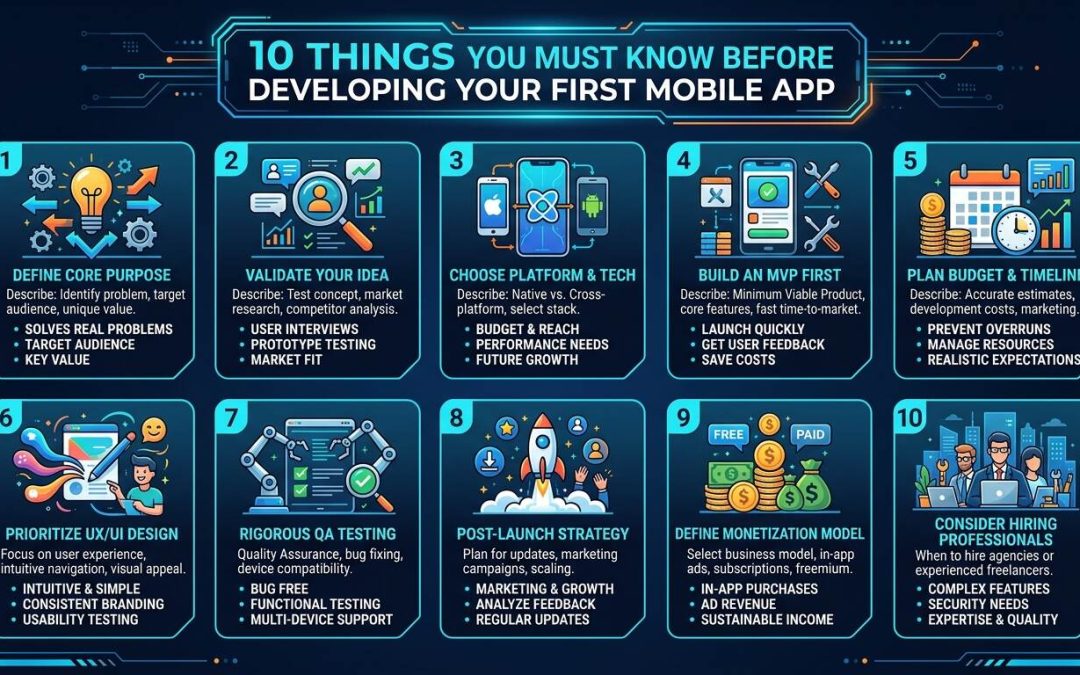
Building a mobile app can be an exciting and rewarding venture. A well-designed app can solve problems, connect people, and even generate significant revenue. For startups and established businesses alike, a mobile app can extend reach, improve customer engagement, and create new opportunities.
However, the path from a simple idea to a successful app is filled with potential pitfalls. Many first-time developers rush into coding without a clear plan, leading to wasted time, blown budgets, and a final product that fails to meet user expectations. This is why understanding the fundamentals of mobile app development before you write a single line of code is critical. A strategic approach helps you avoid common mistakes and sets your project up for success. A well-researched plan helps you identify potential challenges early, allowing you to take proactive steps through proper market research, strategic planning, and smart technical choices.
1. Define Your App’s Core Purpose and Problem
A mobile app is not just a piece of software; it is a solution to a problem. Before you begin, you must clearly define what problem your app solves and for whom.
During this initial phase, ask yourself:
-
What core problem does my app address?
-
Who is my target audience?
-
What are their needs and pain points?
-
How will my app make their life easier or better?
-
What is the unique value proposition?
The goal is to determine whether your app idea has a real market need and a clear reason to exist.
2. Validate Your App Idea Before You Build
Not every good idea is a viable business. Not every problem needs a mobile app solution.
Some assumptions about user needs can remain unverified until you talk to real people and test your concept.
Proper validation helps first-time developers:
-
Confirm market demand
-
Identify potential competitors
-
Refine their value proposition
-
Avoid building a product nobody wants
-
Save significant time and money
Early validation often prevents costly development cycles that lead to failure.
3. Choose the Right Platform and Technology
A key decision that impacts your budget, timeline, and user reach is choosing your platform. Your choice of technology stack will determine how your app is built and who can use it.
Common options include:
-
Native iOS (Swift/Objective-C)
-
Native Android (Kotlin/Java)
-
Cross-platform (React Native, Flutter)
-
Progressive Web Apps (PWAs)
This decision affects performance, development cost, and access to device features. Choosing the right one from the start is crucial.
4. Understand the Importance of an MVP
Building a full-featured app from the start is a common and expensive mistake. The smartest approach is to build a Minimum Viable Product (MVP).
An MVP is the simplest version of your app that delivers the core value to your users.
Developing an MVP helps you:
-
Launch faster to get user feedback
-
Test your core assumptions with real users
-
Save money on initial development
-
Pivot your strategy based on real-world data
-
Secure further investment with a working product
An MVP is not about building less; it is about learning more, faster.
5. Plan for a Realistic Budget and Timeline
Many first-time developers underestimate the cost and time required to build and launch an app.
Without a realistic plan, projects can face:
-
Budget overruns
-
Missed deadlines
-
Reduced feature set
-
Project cancellation
A professional development plan helps reduce these risks by outlining costs for design, development, testing, and marketing before you begin.
6. Prioritize User Experience (UX) and Design
Mobile app development is not only about writing code. It is also about creating a product that people enjoy using.
Good UX and UI design can make or break your app. Specialists may recommend:
-
Creating user personas and journey maps
-
Designing intuitive and simple navigation
-
Ensuring visual consistency and branding
-
Conducting usability tests with real users
-
Designing for accessibility
A great user experience is generally more important than a long list of features.
7. The Critical Role of Quality Assurance (QA) and Testing
Development is only half the battle. Rigorous testing is what ensures your app is reliable and bug-free.
Testing should include:
-
Functional testing
-
Usability testing
-
Performance testing
-
Security testing
-
Device and OS compatibility testing
Regular testing reduces negative reviews and helps ensure a smooth user experience.
8. Why a Post-Launch Strategy is Essential
Releasing your app on an app store is not the finish line; it is the starting line.
A successful launch requires a post-launch strategy, which may include:
-
App Store Optimization (ASO)
-
Marketing and user acquisition campaigns
-
Gathering and analyzing user feedback
-
Planning for regular updates and new features
-
Monitoring app performance and crashes
A professional launch strategy helps you gain visibility and attract your first users.
9. Commercial Apps Require a Strong Business Model
Every successful app needs a way to sustain itself. Businesses often need to decide on a monetization strategy early on.
Common models include:
-
Free with in-app advertising
-
Freemium (free with paid upgrades)
-
Subscription-based
-
Paid app
-
In-app purchases
Regular assessments help you choose a model that aligns with your app’s purpose and your users’ expectations.
10. When Should You Hire a Professional Developer?
First-time developers should consider hiring a professional agency when:
-
The app requires complex features
-
Security is a major concern
-
The timeline is aggressive
-
They lack technical expertise
-
They need to integrate with existing systems
Professional development is especially important for apps handling sensitive data or financial transactions.
Why Professional Development is Better Than DIY
While some founders can build a simple app themselves, most successful apps require professional knowledge and experience.
Professional developers understand:
-
Scalable architecture
-
Modern development frameworks
-
Platform-specific guidelines
-
Security best practices
-
App store submission processes
They also use specialized tools and follow industry best practices to provide accurate estimates and build a quality product.
Professional development reduces guesswork and helps you make informed decisions.
Long-Term Benefits of a Strategic Approach
Investing in proper planning and professional development provides numerous long-term advantages.
Benefits include:
-
Higher chance of market success
-
Lower long-term maintenance costs
-
A more scalable and secure product
-
Faster time to market
-
Better user retention
-
Greater peace of mind
Preventive planning is often more cost-effective than fixing a failed app after launch.
Choosing a Professional App Development Company
When selecting a development partner, consider companies that offer:
-
Experienced developers and designers
-
A clear development process
-
A strong portfolio of successful apps
-
Post-launch support and maintenance
-
Transparent pricing and communication
-
A focus on security and best practices
Working with experienced professionals helps ensure your app is built safely, scalably, and successfully.
Conclusion
Developing your first mobile app is a significant undertaking—one that demands careful planning and realistic expectations. Many first-time developers underestimate the complexity, focusing only on the idea while overlooking the technical, financial, and strategic challenges that determine success or failure.
Understanding these 10 key areas helps you identify hidden challenges early, improve your product’s chances of success, and reduce the risk of failure before it happens. From defining your target audience and validating your concept to choosing the right platform, budgeting realistically, and planning for ongoing maintenance, each area plays a critical role. Ignoring any one can lead to costly delays, wasted resources, or an app that fails to gain traction.
Whether you’re a startup founder, small business owner, or part of an enterprise team, a strategic approach supports a successful launch and a healthier product. Combined with professional development, design, and marketing services when necessary, these steps protect your investment while creating a valuable digital asset—one that engages users, solves real problems, and delivers measurable returns.
FAQs
1. What is the most important thing to do before developing an app?
The most important step is to validate your app idea. Before spending time and money on development, you must confirm that there is a real market need and a target audience willing to use your solution.
2. How much does it cost to develop a mobile app?
The cost varies widely based on complexity, platform, and developer location. A simple MVP can cost a few thousand dollars, while a complex, feature-rich app can cost tens of thousands or more. A professional estimate is crucial for budgeting.
3. Should I build a native or cross-platform app?
It depends on your goals. Native apps offer the best performance and user experience but are more expensive. Cross-platform apps are more cost-effective and faster to build but may have minor performance trade-offs. The right choice depends on your specific needs.
4. How long does it take to develop an app?
A simple MVP might take 2-3 months, while a more complex app can take 6-9 months or longer. The timeline depends on the features, the development team’s size, and the complexity of the design.
5. What happens after I launch my app?
After launch, your work begins. You need to market your app (ASO), gather user feedback, fix bugs, and plan for regular updates. A post-launch strategy is essential for long-term success and user retention.