
A business website is one of the most valuable digital assets a company owns. It helps customers learn about products and services, builds credibility, generates enquiries, and supports online marketing efforts. However, simply having a website is not enough. As businesses evolve, website content can become outdated, inaccurate, or less effective at meeting customer expectations and search engine requirements.
Many business owners focus on creating new content but rarely review the content that already exists. Over time, old blog posts, outdated service pages, broken links, duplicate information, and obsolete contact details can negatively affect both search engine optimisation (SEO) and user experience.
This is where a website content audit becomes valuable.
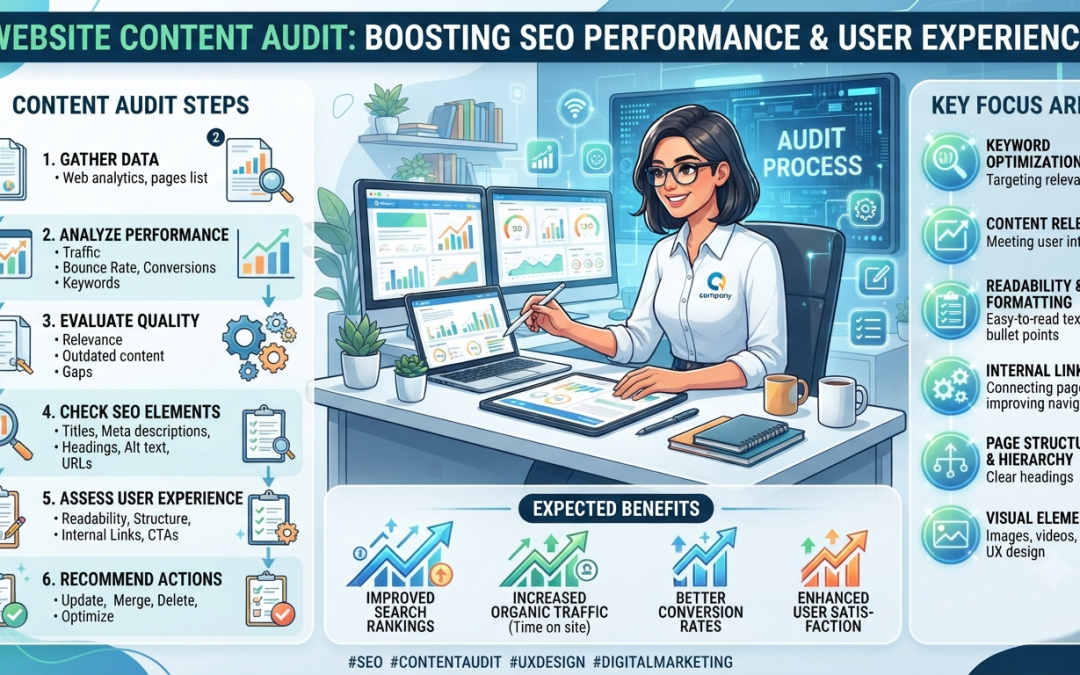
A website content audit is a structured review of all the content on a website. It helps identify areas that need improvement while ensuring that every page continues to support business goals, provide accurate information, and deliver a positive experience for visitors.
Regular website content audits help businesses improve SEO performance, strengthen user engagement, and maximise the value of their online presence.
What Is a Website Content Audit?
A website content audit is the process of reviewing and evaluating every page, blog post, image, and piece of content published on a website.
The objective is to determine whether the content remains accurate, relevant, useful, and optimised for both users and search engines.
During a content audit, businesses typically assess:
- Website pages
- Blog articles
- Landing pages
- Product descriptions
- Images
- Internal links
- Meta titles
- Meta descriptions
Each page is evaluated to determine whether it should be updated, improved, consolidated, redirected, or removed.
Rather than continually adding new content, a content audit ensures existing content continues delivering value.
Why Website Content Changes Over Time
Business websites are constantly evolving.
Products, services, pricing, technologies, and customer expectations all change over time.
As a result, website content that was accurate several years ago may no longer reflect the current business.
Common reasons content becomes outdated include:
- New services
- Updated business information
- Industry changes
- Outdated statistics
- Expired promotions
- Changed contact details
- New SEO best practices
Without regular reviews, outdated content can reduce customer confidence and limit website performance.
How Outdated Content Affects SEO
Search engines aim to provide users with the most relevant and helpful information.
When a website contains outdated or low-quality content, search engines may view it as less valuable than competing websites that regularly update their information.
Common SEO problems caused by outdated content include:
- Lower search rankings
- Reduced organic traffic
- Declining keyword performance
- Duplicate content
- Poor internal linking
- Low user engagement
A website content audit helps identify these issues and provides opportunities to improve search visibility without creating entirely new pages.
Improving User Experience
SEO and user experience work together.
Even if a website ranks well, visitors may leave quickly if they cannot find accurate or useful information.
A content audit helps improve user experience by ensuring visitors can easily find:
- Current service information
- Accurate pricing
- Updated contact details
- Relevant blog articles
- Helpful FAQs
- Clear calls-to-action
When users find reliable information quickly, they are more likely to remain on the website, explore additional pages, and contact the business.
Identifying Low-Performing Content
Not every page on a website contributes equally to business goals.
Some pages generate consistent traffic, while others receive very few visitors.
A website content audit helps identify pages that may require improvement.
Examples include:
- Pages with low search visibility
- Blog posts receiving little traffic
- Content with outdated information
- Pages with high bounce rates
- Duplicate or overlapping articles
Rather than deleting these pages immediately, businesses can often improve their performance by updating and optimising the existing content.
Keeping Business Information Accurate
Customers expect business information to be correct and up to date.
Incorrect details can create frustration and reduce trust.
A content audit helps verify information such as:
- Business descriptions
- Contact information
- Service offerings
- Office locations
- Business hours
- Product specifications
Accurate information improves customer confidence while supporting a more professional online presence.
Strengthening Internal Linking
A website content audit is also an excellent opportunity to review internal linking.
Internal links connect related pages throughout the website, helping visitors navigate more easily while allowing search engines to better understand the website’s structure.
During a content audit, businesses can identify opportunities to:
-
Add links to relevant service pages
-
Connect related blog articles
-
Improve navigation between content
-
Remove broken internal links
-
Update outdated hyperlinks
A strong internal linking strategy helps distribute authority across the website, improves page discovery, and encourages visitors to spend more time exploring additional content.
Improving Content Quality
Search engines increasingly reward websites that publish high-quality, informative, and trustworthy content.
A content audit helps identify pages that may need improvement by reviewing factors such as:
-
Content accuracy
-
Readability
-
Grammar and spelling
-
Content depth
-
Keyword optimisation
-
Page structure
-
Relevance to user intent
Refreshing older content with updated information, clearer explanations, and improved formatting often delivers better results than continually publishing new articles without maintaining existing ones.
High-quality content not only supports SEO but also strengthens brand credibility and customer trust.
Supporting Better SEO Performance
Website content audits play an important role in long-term SEO strategies.
Rather than focusing only on publishing new pages, businesses can improve rankings by optimising the content they already have.
A content audit may reveal opportunities to:
-
Update SEO titles
-
Improve meta descriptions
-
Optimise headings
-
Refresh target keywords
-
Add structured content
-
Improve image optimisation
-
Enhance internal linking
These improvements help search engines better understand each page while making the website more useful for visitors.
Over time, consistent optimisation can contribute to stronger search visibility and more sustainable organic traffic growth.
Eliminating Duplicate Content
As websites grow, duplicate or very similar content can unintentionally appear across multiple pages.
Examples include:
-
Similar service pages
-
Repeated product descriptions
-
Multiple blog articles covering the same topic
-
Duplicate location pages
Duplicate content can confuse search engines and reduce the overall effectiveness of an SEO strategy.
A website content audit helps identify overlapping pages so they can be consolidated, rewritten, or redirected where appropriate.
Maintaining unique, valuable content across the website helps improve both search engine performance and user experience.
Finding Broken Links and Missing Pages
Over time, websites naturally change.
Pages may be removed, URLs updated, or external websites may no longer exist.
These changes can create broken links that negatively affect user experience and SEO.
A content audit helps identify:
-
Broken internal links
-
Broken external links
-
Missing images
-
Redirect errors
-
404 pages
-
Outdated downloadable resources
Fixing these issues helps visitors navigate the website more smoothly while improving overall website quality.
Aligning Content with Business Goals
Business objectives often change over time.
New services may be introduced, target markets may evolve, or branding may be updated.
A content audit ensures the website continues supporting these changes by reviewing whether existing content reflects the company’s current goals.
Businesses can use content audits to:
-
Highlight priority services
-
Promote new solutions
-
Remove outdated messaging
-
Strengthen calls-to-action
-
Improve conversion opportunities
This alignment helps ensure every page contributes to lead generation and business growth rather than simply existing as outdated information.
Why Professional Website Content Audits Matter
Although businesses can review their own websites, professional website content audits provide a much more comprehensive assessment.
Experienced web developers and SEO specialists use professional tools and proven methodologies to evaluate both technical and content-related issues.
A professional audit may include:
-
SEO performance analysis
-
Content quality assessment
-
Technical SEO review
-
Keyword evaluation
-
Internal linking analysis
-
User experience review
-
Website performance recommendations
These insights help businesses prioritise improvements that deliver measurable long-term results.
Long-Term Benefits of Website Content Audits
Regular website content audits provide numerous long-term advantages.
Benefits include:
✔ Improved SEO performance
✔ Better user experience
✔ More accurate business information
✔ Stronger internal linking
✔ Higher content quality
✔ Increased customer trust
✔ Better website engagement
✔ Greater conversion opportunities
Rather than treating a website as a one-time project, regular content audits help keep it relevant, competitive, and aligned with changing business objectives.
Conclusion
A website is never truly finished. As businesses grow, customer expectations change, and search engine algorithms evolve, website content must also be reviewed and updated to remain effective. Without regular maintenance, outdated information, broken links, duplicate content, and declining page quality can gradually reduce both SEO performance and user satisfaction.
A website content audit provides a structured approach to evaluating every page on a website. By identifying outdated content, improving internal linking, updating SEO elements, and ensuring information remains accurate, businesses can strengthen their online presence while providing a better experience for visitors.
Regular content audits also help businesses maximise the value of their existing content. Instead of constantly creating new pages, improving and optimising current content often delivers significant long-term SEO benefits while increasing customer engagement and conversion opportunities.
Whether your goal is to improve search rankings, generate more enquiries, or maintain a professional online presence, regular website content audits are an essential part of a successful digital marketing strategy.
FAQs
1. What is a website content audit?
A website content audit is a detailed review of all the content on a website, including pages, blog posts, images, and metadata. It helps identify outdated information, SEO issues, duplicate content, broken links, and opportunities to improve user experience and website performance.
2. How often should a website content audit be performed?
Most business websites benefit from a content audit at least once or twice a year. Larger websites or those that publish content regularly may require more frequent reviews to ensure information remains accurate, relevant, and optimised for search engines.
3. Can a website content audit improve SEO?
Yes. A content audit helps identify opportunities to improve keyword optimisation, internal linking, metadata, page quality, and content relevance. These improvements can contribute to better search engine rankings and increased organic traffic over time.
4. Does a content audit only focus on blog articles?
No. A professional website content audit reviews all important website content, including service pages, landing pages, product information, blog articles, images, internal links, and metadata to ensure the entire website supports SEO and user experience.
5. Why should businesses hire professionals for a website content audit?
Professional web developers and SEO specialists use advanced tools and industry best practices to identify issues that may not be immediately visible. They can provide practical recommendations to improve website performance, strengthen SEO, and enhance the overall user experience.