
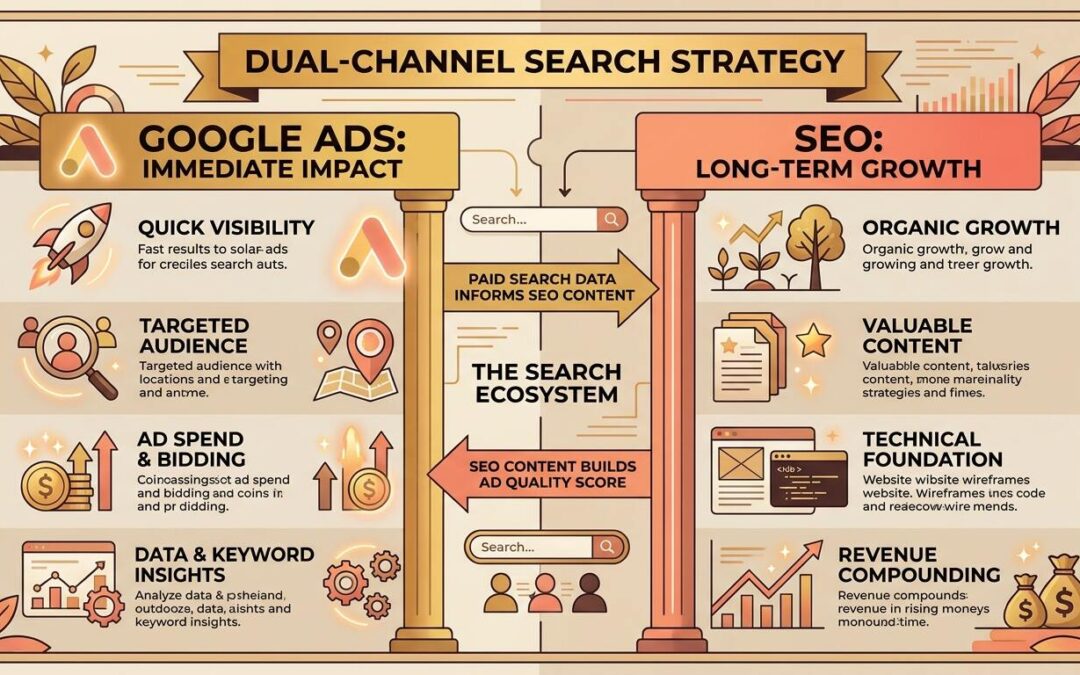
Businesses face a familiar dilemma when allocating marketing budgets: invest in Google Ads for immediate visibility or commit to SEO for sustainable growth. The answer, however, is rarely one or the other. Smart marketers use paid search to generate revenue now while organic search builds momentum for the future.
Many companies make the mistake of treating Google Ads and SEO as competing strategies. They pour their entire budget into one channel, then wonder why growth stalls or costs spiral out of control. The most resilient marketing engines combine both approaches, using each channel to compensate for the other’s weaknesses.
This guide explains how to structure a dual-channel search strategy that delivers immediate revenue while steadily scaling organic traffic.
Understanding the Core Difference Between Google Ads and SEO
Google Ads and SEO serve fundamentally different purposes in a marketing ecosystem.
Google Ads
- Delivers instant visibility
- Your ads appear at the top of search results within hours of launching a campaign
- You pay for every click, but you control exactly who sees your message, when, and where
- Stop paying, and the traffic stops
SEO
- Builds compounding value
- Organic rankings take months to establish,
- Generate traffic without per-click costs
- Rewards consistency and long-term commitment
Neither channel is inherently superior. The right balance depends on your revenue goals, competitive landscape, and growth timeline.
Why Google Ads Delivers Immediate Revenue
Paid search remains one of the fastest ways to generate qualified leads and sales.
Google Ads allows businesses to:
- Capture high-intent searches instantly
- Test messaging and offers with real market feedback
- Control budgets at the campaign, ad group, and keyword level
- Reach specific audiences through targeting and remarketing
- Measure return on ad spend with precision
For new businesses or product launches, Google Ads provides a critical lifeline. You can validate demand, refine your positioning, and generate cash flow before organic rankings mature.
The key is treating Google Ads as a learning engine, not just a revenue tap. Every campaign generates data that informs your broader marketing strategy.
Why SEO Builds Long-Term Growth
Organic search remains the most cost-effective channel for sustained traffic growth.
SEO delivers value through:
- Compounding returns as rankings improve
- Reduced customer acquisition costs over time
- Authority and trust signals that influence buying decisions
- Traffic that continues without ongoing ad spend
- Resilience against rising paid advertising costs
SEO also captures demand across the entire funnel, from informational queries to transactional searches. This breadth makes organic search indispensable for brands seeking durable market presence.
The challenge is that SEO requires time, technical expertise, and consistent content investment. Results rarely appear overnight, which is why pairing SEO with paid search creates a more balanced growth engine.
The Hidden Risks of Choosing Only One Channel
Committing exclusively to Google Ads or SEO introduces significant vulnerabilities.
A paid-only strategy exposes businesses to:
- Rising cost-per-click as competition increases
- Ad fatigue and declining returns without constant optimization
- Complete traffic loss if campaigns pause or budgets shrink
- Dependence on platform policies and algorithm changes
An SEO-only strategy creates different risks:
- Slow time-to-revenue for new businesses
- Vulnerability to search algorithm updates
- Difficulty responding quickly to market shifts
- Missed opportunities in high-intent paid placements
The solution is not to pick a side but to design a strategy where each channel strengthens the other.
How to Use Google Ads to Fund and Accelerate SEO
Google Ads can do more than generate immediate sales. It can actively support organic growth.
Businesses can use paid search to:
- Identify high-converting keywords worth targeting in SEO
- Test landing page messaging before investing in content
- Discover audience segments that respond to specific offers
- Generate revenue that funds ongoing SEO investment
- Gather search term data that reveals content opportunities
This feedback loop is invaluable. Instead of guessing which keywords deserve SEO attention, you let paid search data guide content priorities.
How SEO Improves Google Ads Performance
Organic search also strengthens paid campaigns in meaningful ways.
SEO efforts can:
- Increase brand recognition, improving ad click-through rates
- Build landing pages that convert paid traffic more effectively
- Establish topical authority that boosts Quality Scores
- Reduce overall customer acquisition costs by supplementing paid traffic
- Provide content assets for ad extensions and remarketing
When SEO and Google Ads work together, the whole becomes greater than the sum of its parts.
Building a Budget Allocation Framework
Effective budget allocation balances immediate revenue needs with long-term growth goals.
A practical framework might include:
- Allocating 60-70% of search budget to Google Ads during launch phases
- Reserving 30-40% for SEO content and technical foundations
- Gradually shifting toward SEO as organic rankings mature
- Maintaining paid search for high-competition or high-value keywords
- Reinvesting paid search profits into content expansion
This approach ensures immediate revenue while steadily reducing dependence on paid traffic.
The exact split depends on industry competitiveness, profit margins, and growth stage. The principle remains consistent: use paid search to survive and thrive now, while building organic assets for the future.
Testing and Optimization: The Shared Discipline
Both Google Ads and SEO require continuous testing and refinement.
Shared optimization practices include:
- A/B testing landing pages and ad copy
- Analyzing search query data for intent signals
- Monitoring conversion rates across devices and audiences
- Refining keyword targeting based on performance
- Tracking customer lifetime value, not just click costs
Businesses that treat testing as a core discipline extract more value from both channels.
Measuring Success Across Both Channels
Attribution remains one of the most challenging aspects of search marketing. Customers rarely convert on their first interaction.
Effective measurement should account for:
- Multi-touch attribution across paid and organic touchpoints
- Assisted conversions where organic content supports paid campaigns
- Branded search lift resulting from paid visibility
- Customer acquisition cost trends over time
- Organic traffic growth alongside paid revenue
Looking beyond last-click attribution reveals the true impact of a combined strategy.
Common Mistakes to Avoid
Several pitfalls undermine dual-channel search strategies.
Avoid:
- Treating SEO and Google Ads as isolated teams
- Cutting SEO investment when paid campaigns succeed
- Ignoring organic keyword data when building paid campaigns
- Over-relying on paid search without building organic assets
- Measuring channels separately without considering their interaction
Alignment between paid and organic teams produces better results than siloed execution.
When to Prioritize Google Ads Over SEO
Certain situations favor paid search as the primary channel.
Google Ads should take priority when:
- Launching a new business or product with immediate revenue needs
- Entering highly competitive markets where organic rankings take years
- Running time-sensitive promotions or seasonal campaigns
- Testing new markets before committing to content investment
- Operating in industries with rapidly changing search demand
In these scenarios, Google Ads provides the speed and flexibility that SEO cannot match.
When to Prioritize SEO Over Google Ads
Other scenarios favor organic search investment.
SEO should take priority when:
- Building long-term brand authority in a niche
- Targeting informational queries with high content potential
- Operating with limited budgets that cannot sustain paid campaigns
- Competing in industries where organic trust signals drive conversions
- Seeking to reduce customer acquisition costs over time
SEO also becomes more important as paid advertising costs rise in competitive sectors.
The Ideal Scenario: A Unified Search Strategy
The most effective approach integrates Google Ads and SEO into a single, coordinated strategy.
This unified approach includes:
- Shared keyword research informing both paid and organic campaigns
- Landing pages optimized for both paid traffic and organic rankings
- Content strategies that support ad messaging and organic authority
- Budget planning that balances immediate and long-term returns
- Reporting that captures cross-channel influence
When executed well, this strategy generates immediate revenue while building a durable organic foundation.
Conclusion
Choosing between Google Ads and SEO is a false dilemma. The businesses that grow fastest and most sustainably use paid search to generate revenue now while investing in organic search for the future.
Google Ads provides speed, control, and immediate market feedback. SEO provides compounding returns, authority, and long-term cost efficiency. Together, they create a search marketing engine that delivers results at every stage of growth.
Start with paid search to validate demand and generate cash flow. Use those insights to guide SEO investment. As organic rankings mature, gradually reduce dependence on paid traffic while maintaining campaigns for high-value keywords.
The goal is not to pick a winner but to build a system where each channel makes the other stronger.
FAQs
1. Should I invest in Google Ads or SEO first?
If you need immediate revenue, start with Google Ads. If you have time to build long-term traffic, prioritize SEO. Most businesses benefit from starting with paid search to generate cash flow, then reinvesting profits into SEO for sustainable growth.
2. Can Google Ads and SEO work together effectively?
Yes. Google Ads provides keyword and conversion data that informs SEO priorities. SEO builds brand authority and landing pages that improve paid campaign performance. Together, they reduce overall acquisition costs and increase market coverage.
3. How long does SEO take to show results compared to Google Ads?
Google Ads can generate traffic and conversions within hours of launch. SEO typically takes three to six months to show meaningful results, with full impact often taking twelve months or more depending on competition and content quality.
4. How should I split my budget between Google Ads and SEO?
A common starting point is 60-70% toward Google Ads and 30-40% toward SEO during early growth phases. As organic rankings improve, gradually shift the balance. The ideal split depends on your industry, margins, and growth timeline.
5. What metrics should I track for a combined search strategy?
Track cost per acquisition, return on ad spend, organic traffic growth, keyword ranking improvements, conversion rates by channel, customer lifetime value, and branded search volume. Multi-touch attribution provides the most accurate picture of cross-channel impact.