
Mobile apps are essential for connecting with users, streamlining operations, and delivering digital experiences—but success starts before the first line of code. Choosing the right development platform affects speed, cost, scalability, and user experience.
Many organizations rush into development without evaluating their options, only to find their platform can’t support growth, needs costly workarounds, or limits multi-device reach. Understanding platforms and their trade-offs is critical before committing.
A well-chosen platform aligns with your requirements, team skills, budget, and long-term goals—setting the foundation for an app that evolves with your needs.
What Is a Mobile App Development Platform?
A mobile app development platform is a comprehensive environment that provides the tools, frameworks, and infrastructure needed to design, build, test, and deploy mobile applications .
These platforms range from full-code development environments used by professional engineers to visual builders that enable non-technical users to create functional apps. The right platform for any given project depends on multiple factors, including the complexity of the application, the technical expertise available, and the desired user experience.
When evaluating platforms, consider what each type offers:
Native development environments
Xcode for iOS and Android Studio for Android provide direct access to platform-specific features and maximum performance.
Cross-platform frameworks
Flutter and React Native allow developers to write code once and deploy to both iOS and Android.
No-code and low-code platforms
Enable visual development through drag-and-drop interfaces, making app creation accessible to users without programming experience.
Why Choosing the Right Platform Matters
Not every platform suits every project, and choosing poorly can lead to significant consequences.
Some organizations discover too late that their chosen platform cannot handle their app’s performance requirements as user numbers grow. Others find themselves locked into a proprietary system that makes migration to new technologies expensive and time-consuming. Still others struggle with platforms that lack the integrations their business depends on.
Selecting the right platform helps organizations:
- Reduce development time and costs
- Access required device features and integrations
- Scale the application as user demand grows
- Maintain the app efficiently over its lifecycle
- Reach target audiences on their preferred devices
The platform decision also affects hiring and team structure. A React Native project requires different expertise than a Flutter project, and no-code platforms require different skill sets entirely.
Understanding the Main Development Approaches
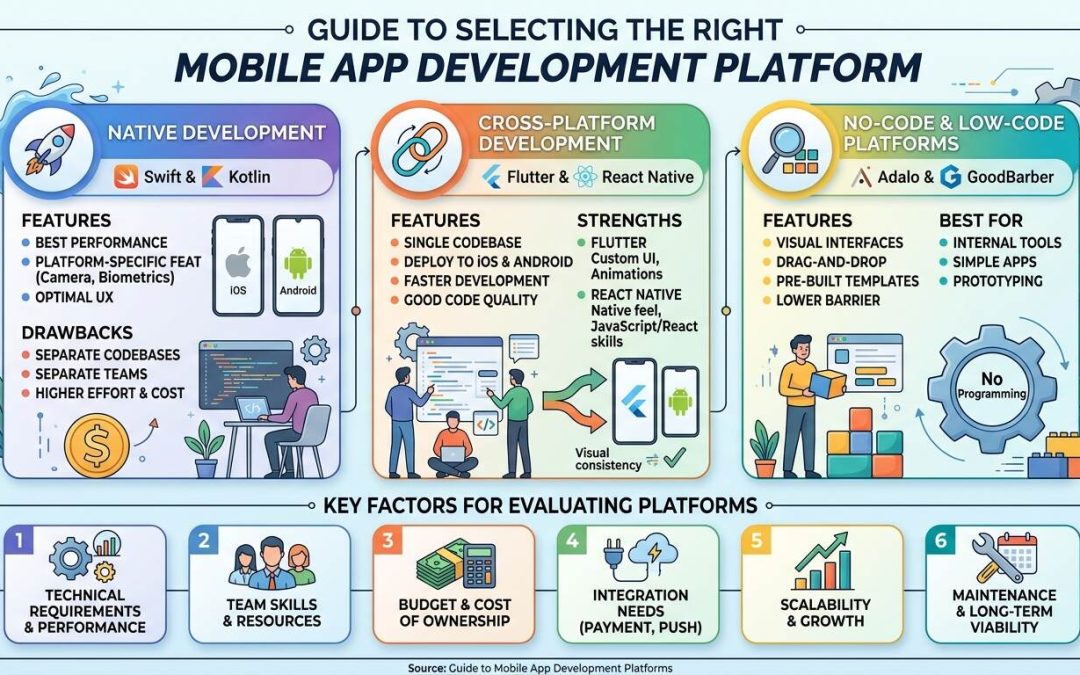
Mobile app development generally falls into three primary categories, each with distinct characteristics, advantages, and limitations.
Native Development
Uses platform-specific languages and tools such as Swift or Objective-C for iOS and Kotlin or Java for Android.
Advantages:
- Best possible performance
- Complete access to device features (camera, biometrics, latest OS features)
- Optimal user experience
Disadvantages:
- Requires separate codebases for iOS and Android
- Needs separate development teams
- Roughly double the development effort and cost
Cross-Platform Development
Single codebase runs on both iOS and Android with two dominant options which are Flutter and React Native.
Flutter
-
Exceptional visual consistency across platforms
-
Supports complex custom animations
-
Faster development while maintaining good code quality
React Native
-
Native feel while sharing business logic
-
Extensive npm ecosystem
-
Natural fit for teams with existing React/JavaScript expertise
No-Code and Low-Code Platforms
Enable app creation through visual interfaces with drag-and-drop components and pre-built templates. It also dramatically lowered barrier to mobile app development.
Examples:
- Adalo – focuses on true native output from single codebase
- GoodBarber – built-in features for e-commerce, restaurants, service businesses
By 2025, 70% of new mobile applications predicted to be built using low-code or no-code technologies
Best for:
- Internal tools
- Simple customer-facing apps
- Rapid prototyping
Limitations:
- Constrained customization options
- May struggle with high-performance needs
- Potential vendor lock-in challenges
Key Factors for Evaluating Platforms
Choosing the right platform requires honest assessment of several interconnected factors.
Technical Requirements and Performance Needs
Specific features your app requires should guide platform selection.
Consider:
- Complex animations, custom graphics, real-time processing = higher demands
- Simple content delivery or form-based tools = lower demands
Platform performance:
- Flutter excels at custom UI and animation
- Native development provides best performance for computationally intensive tasks
- Cross-platform and well-chosen no-code solutions deliver satisfactory performance for standard business applications
Integration requirements:
- Payment processing
- Push notifications
- Camera access
- Third-party services
- Depends on available SDKs and plugin ecosystems
- React Native benefits from extensive npm ecosystem
- Flutter has official plugins maintained by Google
Team Skills and Resources
Expertise within organization or accessible through hiring significantly influences choice.
Team considerations:
- JavaScript/React experience → React Native with minimal friction
- No programming resources → no-code platforms more practical
- Flutter requires learning Dart (less common than JavaScript)
Ongoing maintenance:
- Consider not just initial development but long-term support
- Platform your team can support prevents expensive external contracts
Budget and Total Cost of Ownership
Development costs vary dramatically across platforms.
Cost comparison:
- Native development for both platforms: tens of thousands of dollars or more
- Cross-platform development: reduced costs by sharing code
- No-code platforms: monthly subscriptions ranging from ~$36 to $90 per month
Additional cost considerations:
- Development time
- Ongoing maintenance
- Potential migration costs if outgrowing platform
- Revenue-sharing or transaction fees
- Some platforms take commissions on app revenue
- Others charge flat fees
Target Platforms and Distribution
Decide which platforms your app must reach.
Coverage considerations:
- iOS and Android cover most users globally
- Some audiences may require web access through Progressive Web Apps
Platform output:
- Cross-platform frameworks typically target both major mobile platforms from one codebase
- No-code platforms vary in output options, some produce true native apps while others create web wrappers with performance or feature limitations
Scalability and Long-Term Viability
Platform must support app’s growth trajectory.
Consider:
- How needs might change as user numbers increase
- Feature expansion requirements
- Evolving requirements
Scalability paths:
- Native and established cross-platform frameworks offer proven scalability
- Some no-code platforms have made significant infrastructure investments
Research before committing:
- Platform’s track record
- Platform’s roadmap
Common Pitfalls to Avoid
Many organizations encounter predictable challenges when selecting development platforms.
Choosing based on price alone often leads to platforms that cannot meet requirements or require expensive workarounds. The cheapest option rarely delivers the best long-term value .
Underestimating customization needs causes problems when generic templates cannot accommodate unique business logic or branding requirements .
Ignoring vendor lock-in can trap organizations on platforms that make migration difficult or impossible without complete rebuilding .
Overlooking maintenance requirements leaves teams unprepared for the ongoing effort of keeping apps updated, secure, and compatible with new OS versions.
Failing to validate with real users means discovering usability issues after launch rather than during development when changes are less costly.
Making the Decision: A Practical Framework
When evaluating mobile app development platforms, work through these questions systematically:
- What is the core purpose of the app?
- Who will build and maintain it?
- What is the realistic budget?
- How will the app need to evolve?
- What is the exit strategy?
Arranging demonstrations from shortlisted platforms provides valuable insight into actual functionality and workflow . Test critical features before committing.
Conclusion
Selecting the right mobile app development platform is a foundational decision that shapes your project’s success, cost, and future flexibility. Native development offers maximum performance and platform access at higher cost and complexity. Cross-platform frameworks like Flutter and React Native balance efficiency with capability. No-code and low-code platforms democratize app creation for simpler use cases.
There is no universally correct answer—only the right choice for your specific requirements, resources, and goals. By understanding the trade-offs, honestly assessing your needs, and evaluating platforms against practical criteria, you can choose a development approach that delivers your app successfully and supports your long-term objectives.
FAQs
1. What is a mobile app development platform?
A mobile app development platform is a comprehensive environment providing tools, frameworks, and infrastructure for designing, building, testing, and deploying mobile applications. Platforms range from professional development environments like Xcode and Android Studio to cross-platform frameworks like Flutter and React Native, to visual no-code builders that enable app creation without programming .
2. What is the difference between native and cross-platform development?
Native development builds separate applications for each platform using platform-specific languages—Swift for iOS and Kotlin for Android. This provides the best performance and fullest access to device features but requires separate codebases. Cross-platform development uses a single codebase to create apps for both platforms, reducing development time and cost while potentially sacrificing some performance or platform-specific capabilities .
3. Should I use Flutter or React Native?
Flutter and React Native are both capable cross-platform frameworks. Flutter excels at custom UI and visual consistency across platforms, making it ideal for design-forward applications. React Native is often preferred by teams with existing JavaScript and React expertise and benefits from a larger ecosystem of community packages . The best choice depends on your team’s skills and your app’s specific requirements.
4. Are no-code platforms suitable for professional apps?
No-code platforms have become increasingly capable and can produce professional-quality apps for many use cases, particularly internal tools, simple customer-facing applications, and MVPs. However, they may have limitations for complex requirements, high-performance needs, or extensive customization . Evaluate whether your specific needs fall within the platform’s capabilities.
5. How much does it cost to build a mobile app?
Costs vary enormously based on complexity, platform choice, and development approach. Native development for both platforms can cost from thousands to over $100,000 for complex applications. Cross-platform development reduces costs by sharing code. No-code platforms typically charge monthly subscriptions starting around $36-$90 per month, though this covers platform access rather than custom development.